

Dorval, September 30, 2026
To: Mr. Jean-François Bergeron, President and Chief Executive Officer, Loto-Québec 500 Sherbrooke Street West, Montréal (Québec) H3A 3G6
Copies: The leaders of Quebec’s political parties · Members of the media
Subject: Loto-Québec’s notice of November 24, 2025 (removal of video lottery terminals, licence 21634) and the structural conflict of interest in Quebec’s VLT system
Mr. Bergeron, party leaders, members of the media,
We are writing to all of you at once, and publicly, because the decision described below was made by Loto-Québec alone, will be carried out under the government elected on October 5, 2026, and has so far been examined by no one outside Loto-Québec.
La Source du Sexe is a licensed, family-run establishment in Dorval. On November 24, 2025, Loto-Québec informed us that the video lottery terminals (VLTs) in our establishment will be removed after November 26, 2026. We did nothing wrong, and the notice says so. What the notice does show, on a single page, is the problem at the centre of Quebec’s VLT system: one public corporation sells gambling, decides where it may be sold, sets the standards it applies to others, and keeps the profit. No independent body checks its work.
This letter sets out what the notice says, why its stated justification does not hold up, how it fits a pattern already seen in Rimouski, how the conflict can be removed by making Loto-Québec the regulator of gambling rather than its operator, and what we are asking of each of you.
1. The notice of November 24, 2025
On November 24, 2025, Loto-Québec delivered by messenger a letter titled “Préavis – Retrait des appareils de loterie vidéo” to La Source du Sexe (licence 21634), 2335 Hymus Boulevard, Dorval. Signed by Ms. Stéphanie Guertin, Director of Commercial Operations, it informs us that the Société des établissements de jeux du Québec (SEJQ), a Loto-Québec subsidiary, will terminate our Agreement for the installation and operation of video lottery terminals and remove the terminals after November 26, 2026. The letter presents itself as the written notice provided for in article 21 of the Agreement. It is reproduced in Annex A, with an. English translation.
Its entire justification reads as follows (our translation):
“Loto-Québec is reviewing the model of its land-based offering so that it better meets current issues and needs. As part of this process, Loto-Québec wishes to modernize its video lottery offering and ensure a safe gaming experience for the Quebec population, through a network of entertaining establishments. This process involves, in particular, the concentration of video lottery terminals (‘VLTs’) in establishments meeting enhanced standards. To do so, it is therefore necessary to remove a certain number of VLTs.”
2. What the notice says, and what it does not
Read on its own terms, the notice contradicts the objectives it invokes.
2.1 It confirms we did nothing wrong
The notice states that removals resulting from a retailer’s breach of its legal or contractual obligations “are not covered by this project.” Our removal is therefore not a sanction. It is a business decision about a retailer in good standing.
2.2 “Concentration” is not reduction
The notice does not say the terminals will be taken out of circulation. It says they will be concentrated in other establishments. Moving a terminal from one venue to another, often a larger one, does not reduce the gambling available to Quebecers. Concentrating terminals in bigger, more immersive venues is the gaming-hall model, which is built to increase the time and money spent per visit. If the goal were harm reduction, the notice would announce fewer terminals in Quebec. It announces a relocation.
2.3 The rationale is commercial, and so is the signatory
The notice uses marketing language: “modernize the offering,” a “network of entertaining establishments,” a model that “better meets current needs.” It is signed by the Director of Commercial Operations and invites us to contact our “commercial representative.” It is not signed by a public-health authority or by a regulator. The division responsible for selling gambling decided, on its own, who may continue to offer it.
2.4 The “enhanced standards” are never defined
The notice does not say what the “enhanced standards” are, where they are published, when they were adopted, how our establishment was assessed, or where it falls short. We were given no chance to meet them and no way to contest the finding. A regulator applying a standard has to disclose it. A commercial operator choosing its customers does not. That is the problem.
2.5 “A safe gaming experience,” with no evidence about our establishment
Our establishment is licensed, restricted to adults and supervised, and it has operated under its VLT agreement in good standing, as the notice itself implicitly confirms. The notice does not claim, let alone show, that play at La Source du Sexe is less safe than play in the establishments that will receive the relocated terminals.
2.6 One year’s notice, no compensation, no recourse
The notice relies on article 21 of an agreement drafted by Loto-Québec and offered to retailers on a take-it-or-leave-it basis. It provides no compensation, no transition measures and no appeal. For a small family business whose premises, staffing and investments were organized around that agreement, the loss is real. It is imposed by the same entity that will keep collecting the revenue once the terminals are moved.
2.7 The independent regulator is absent
The Régie des alcools, des courses et des jeux (RACJ) is not mentioned anywhere in the notice. The decision was made and communicated entirely by Loto-Québec and the SEJQ. Loto-Québec decides which venues lose their terminals, which venues receive them and what the standards are, and it keeps the profit. It is judge, party and beneficiary at once.
2.8 Implementation after the election
Removal is scheduled for after November 26, 2026, seven weeks after the October 5 general election. The decision will be carried out under the next government, which still has time to require transparency before it takes effect.
3. The structural conflict of interest
Loto-Québec operates VLTs, sets the commercial rules under which they are deployed, funds much of the prevention and research work that studies their effects, and remits its profits to the Government of Québec, its sole shareholder. Every one of these roles pulls toward revenue. The notice shows how this works in practice. A network-wide decision about where gambling will be offered is made by the commercial arm, justified in public-health language, and verified by no one. Neither the criteria nor the claimed benefit is ever tested by a body that does not profit from the outcome.
4. Quebec already knows better: the tobacco model
Quebec chose to own and sell gambling (Loto-Québec), alcohol (SAQ) and cannabis (SQDC). With tobacco it chose the opposite model: it regulates and taxes an industry it does not own, and it has taken manufacturers to court to recover health-care costs. That arm’s-length model exists because a government that profits from a product cannot credibly police it.
For VLTs, Quebec kept the seller and the gatekeeper under one roof. A notice in which a commercial director decides which lawful businesses may keep offering a product the state sells is the predictable result.
5. The solution: Loto-Québec as regulator, not operator
The conflict described above cannot be fixed with better intentions or a larger prevention budget. It comes from the structure itself: the body that sets the rules also earns the revenue those rules produce. The remedy is to separate the two roles.
We propose that Loto-Québec stop operating gambling itself (casinos, gaming halls and the VLT network) and become the public authority that authorizes, sets standards for and supervises it. Day-to-day operation would be carried out by licensed operators and retailers under published rules, with Loto-Québec on the other side of the table.
What the separation changes
• Standards become public. A regulator has to publish its rules, apply them to everyone and give reasons when it acts. The “enhanced standards” in the notice would have to exist in writing, and be met or failed on the record, before anyone lost a licence.
• Decisions become reviewable. Where terminals may be placed, and when they are withdrawn, would be regulatory decisions with written reasons and a right of appeal, not the use of a termination clause in a commercial contract.
• The regulator stops competing with the people it regulates. Today Loto-Québec removes terminals from small retailers while expanding gaming halls that it operates itself. A regulator that owns no venue has no reason to steer players toward its own.
• State revenue moves to arm’s length. Quebec would still collect its share, through licence fees and a gaming tax set by law, as it does with tobacco. Public revenue would no longer depend on Loto-Québec’s own sales, so the regulator would gain nothing by favouring one venue over another.
• Prevention is funded independently. A dedicated levy on all operators, administered by public-health authorities rather than by the regulator or the operators, would fund prevention and research. What gets studied would no longer be decided by the party being studied.
• Harm reduction becomes measurable. A regulator that does not sell can set targets on total gambling exposure and report on them. An operator will always prefer to talk about relocating supply.
This model already exists in Canada and abroad
• Ontario: the Alcohol and Gaming Commission of Ontario (AGCO) regulates and registers operators. iGaming Ontario conducts and manages online gaming through private operators registered by the AGCO, and OLG’s land-based casinos are run day to day by private service providers under contract.
• British Columbia: on April 13, 2026, the Gaming Control Act created the Independent Gambling Control Office, which can issue directives to BCLC without the minister’s consent. The reform followed the German Report and the Cullen Commission, which found the line between regulator and operator too blurred.
• United Kingdom: the Gambling Commission licenses and supervises operators but runs no games; even the National Lottery is operated by a licensee under its supervision.
The Criminal Code does not stand in the way
Section 207 of the Criminal Code requires lottery schemes, including VLTs and casino games, to be “conducted and managed” by the province. Ontario shows that a province can keep that legal responsibility (authorizing each scheme, holding the contracts, setting the rules and receiving the revenue) while leaving the running of venues and machines to licensed operators and giving compliance oversight to a body that does not profit from sales. Nothing in federal law requires Quebec to have one corporation sell gambling, choose its own customers and police itself.
Separation is not deregulation
Commercial operators have commercial incentives too. That is exactly why they need a regulator that is not also a competitor. The normal model in regulated industries is a public authority supervising operators whose interests it does not share. What Quebec has today is the exception: an authority whose interests are those of the operator, because it is the operator.
6. Loto-Québec’s usual defences, answered
• “The RACJ regulates us.” The RACJ issues licences, but it did not make, review or sign this decision. Where terminals go, and under what standards, remains Loto-Québec’s choice.
• “Our profits go back to Quebecers.” That is exactly why the conflict exists. The government that receives the dividend is also responsible for protecting players. A revenue interest is not a safeguard.
• “We fund responsible gaming.” Funding prevention is welcome. But an operator that funds its own oversight decides what gets studied and what does not. The party being overseen cannot buy its own independence.
• “This is about reducing accessibility.” Then publish the numbers: how many terminals are leaving Quebec altogether, and how many are simply moving to larger venues. The notice speaks only of concentration.
• “Retailers accepted the contract.” The contract was written by Loto-Québec, the only legal VLT supplier in the province. A retailer has no one else to negotiate with. Invoking a termination clause in such a contract is an exercise of market power, not public-interest regulation.
• “The Criminal Code requires the province to run gambling.” It requires the province to conduct and manage it, not to operate every venue itself. Ontario conducts and manages gaming through private operators under a separate regulator. The choice to combine all three roles in one corporation is Quebec’s, not Ottawa’s.
7. A pattern, not an isolated case: Rimouski
In Rimouski, Loto-Québec removed VLTs from bars de danseuses while it sought municipal approval for a larger gaming hall. The removals were presented as a responsible gesture. In practice they served as an opération charme to secure rezoning for a bigger gambling venue, and the Mayor of Rimouski has since publicly insisted that Loto-Québec honour its commitments on the project (Radio-Canada).
The notice we received applies the same logic across Quebec: take terminals out of small, stigmatized venues, concentrate them in larger ones, and call it modernization. Removing terminals from some lawful establishments while keeping or adding them elsewhere is not a consistent regulatory rule. It is a selection, made without published criteria, without compensation and without any demonstrated reduction in total gambling exposure. People who want to play will play elsewhere, often in venues designed to keep them playing longer.
8. A rights dimension
Establishments like ours are lawful, licensed businesses whose workforce is predominantly female. If the selection falls on such venues, as it did in Rimouski, without published criteria tied to player safety, it may produce adverse-effect discrimination: a measure that looks neutral but whose burden falls disproportionately on a group protected by section 10 of the Quebec Charter of Human Rights and Freedoms (sex). Because Loto-Québec is a state-owned corporation, it also raises questions under the equality guarantee in section 15 of the Canadian Charter of Rights and Freedoms.
Stigma is not a public-health criterion. At a minimum, Loto-Québec should have to show that its “enhanced standards” rest on player-safety evidence and not on the image of the venue.
9. What we are asking Of Loto-Québec
1. Suspend the notice of November 24, 2025 until the requests below have been answered.
2. Publish the “enhanced standards”: their full text, the date they were adopted and the authority that approved them.
3. Disclose the assessment of our establishment, identify the standard we are said not to meet, and give us a reasonable opportunity to meet it.
4. Publish, for all of Quebec, how many terminals are being permanently withdrawn and how many are being relocated, and to what categories of establishment.
5. State what player-safety evidence supports the selection, and whether its effect on a predominantly female workforce was assessed.
6. Provide compensation and transition measures to retailers in good standing whose agreements are terminated.
Of the party leaders, before October 5
1. Commit to a moratorium on removals under this program until an independent review has been completed.
2. Commit to legislation that separates the regulation of gambling from its operation: Loto-Québec would authorize, set standards for and supervise casinos, gaming halls and VLTs, and would no longer operate them itself.
3. Pending that reform, commit to giving the power to decide where VLTs are placed, and to set the applicable standards, to a body independent of Loto-Québec’s commercial operations, with published criteria and a right of appeal.
4. Commit to funding gambling prevention and research through a body independent of Loto-Québec.
5. Say publicly whether your party supports a model in which the seller of gambling is also its gatekeeper.
Of the media
Put these questions to Loto-Québec: what the “enhanced standards” are, how many terminals are leaving Quebec rather than moving, and which establishments will receive them. We will provide the notice and supporting documents on request and are available for interviews.
We are not asking for special treatment. We are asking that a decision affecting lawful businesses, their employees and public health be made under rules that are published, applied consistently and checked by someone other than the party that profits from the outcome.
Respectfully,
Signed electronically · September 30, 2026
Nicolas Aliftiras
Director of Operations
La Source du Sexe
2335 Hymus Blvd.
Dorval, QC H9P 1J8
Email: Nicolasaliftiras@gmail.com
Cell: (514) 609-5597
Enclosure: Annex A – Loto-Québec, “Préavis – Retrait des appareils de loterie vidéo,” November 24, 2025 (original and unofficial English translation).
Annex A – Loto-Québec notice of November 24, 2025
Reproduced as received (original in French). An unofficial English translation follows on the next page. 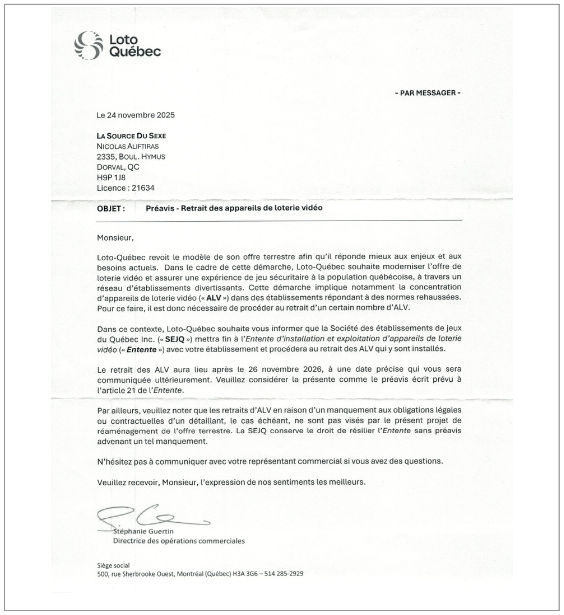
Annex A – Unofficial English translation
Translation by La Source du Sexe. The French original governs.
— BY MESSENGER —
November 24, 2025
LA SOURCE DU SEXE
Nicolas Aliftiras
2335 Hymus Blvd.
Dorval, QC H9P 1J8
Licence: 21634
SUBJECT: Notice – Removal of video lottery terminals
Sir,
Loto-Québec is reviewing the model of its land-based offering so that it better meets current issues and needs. As part of this process, Loto-Québec wishes to modernize its video lottery offering and ensure a safe gaming experience for the Quebec population, through a network of entertaining establishments. This process involves, in particular, the concentration of video lottery terminals (“VLTs”) in establishments meeting enhanced standards. To do so, it is therefore necessary to remove a certain number of VLTs.
In this context, Loto-Québec wishes to inform you that the Société des établissements de jeux du Québec Inc. (“SEJQ”) will terminate the Agreement for the installation and operation of video lottery terminals (the “Agreement”) with your establishment and will remove the VLTs installed there.
The VLTs will be removed after November 26, 2026, on a specific date that will be communicated to you later. Please consider this letter as the written notice provided for in article 21 of the Agreement.
Please also note that VLT removals resulting from a retailer’s breach of its legal or contractual obligations, where applicable, are not covered by this project to redevelop the land-based offering. The SEJQ retains the right to terminate the Agreement without notice in the event of such a breach.
Do not hesitate to contact your commercial representative if you have any questions.
Yours sincerely,
[signature]
Stéphanie Guertin
Director of Commercial Operations
Head office: 500 Sherbrooke Street West, Montréal (Québec) H3A 3G6 – 514 285-2929